Not a bad practice today. I started with the usual scales and arps and really, really focused on using my forearms and not just my hand/finger strength to strike the keys. This "fingery playing" is a technique issue I've been dealing with for some time, and habits are hard to break--particularly when no one's ever corrected the habit before. But the arm-thing has begun to feel more natural. I'm getting there.
My "intermediate" piece, "The Elf," is from a series of short pieces by Robert Schumann. Here's a blurb from Music Web International:
"The Albumblätter are twenty miscellaneous little pieces, sounding much like other miscellaneous little Schumann pieces; the playing is precise, dramatic, and idiomatic, but at times I found it hard to keep my attention on them, even though number 17, ‘Elfe,’ is a marvel of pianistic skill. Some may prefer these rather cool performances, but I look for those uniquely Schumann passions in this music and I don’t hear them here." -- Paul Shoemaker
"Elfe." That's the piece I'm learning. I like it with an "e" at the end.
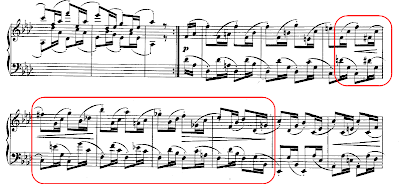
Here's the main part of "Elfe" I worked on today:
To be honest, I'm not crazy about this piece; I much prefer the lushness of Liszt, or even of heavier Schumann pieces. But this one is a nice change of pace, and who knows--since it is "a marvel of pianistic skill," it might be a fun little encore piece, if I ever find my way to a concert stage of any kind (and if I ever learn to play it half-decently).
I didn't have much time after wrestling with "Elfe" for 25 minutes, but I wanted to touch on all the other pieces if nothing else. So I didn't spend a lot of time on the prelude and fugue. I spent last night's practice on a few glitches that had come up in the first two pages of the fugue, so I played through that section again today and it sounded nice. The prelude ... ahh. What a wonderful piece of music. And it is slowly becoming mine.
I really didn't have time for Liszt, but I couldn't stand to leave my practice session without at least checking in on him. (I don't know why I've adopted the principle, "Save the Liszt for Last," but I have. Actually, I do know why. Maybe I'll write more on that later.)
Sounded good. That piece is mine, too. Except for the second 9-against-4 measure, which continues to drive me batty.
Oddly enough, the first 9-against-4 is no longer a problem. It's played with passion and drive. But the second is a bit slower, and a lot more reflective. It's hard to give a sense of whimsical reflection while trying to play 9-against-4. It really is.
So I was late getting back to work. Sadness.
I love the way music messes with my mind. I got the giggles on the walk back to work, picturing a little elfe-like figure riding on the subway in D.C.: A Metro Gnome.
My "intermediate" piece, "The Elf," is from a series of short pieces by Robert Schumann. Here's a blurb from Music Web International:
"The Albumblätter are twenty miscellaneous little pieces, sounding much like other miscellaneous little Schumann pieces; the playing is precise, dramatic, and idiomatic, but at times I found it hard to keep my attention on them, even though number 17, ‘Elfe,’ is a marvel of pianistic skill. Some may prefer these rather cool performances, but I look for those uniquely Schumann passions in this music and I don’t hear them here." -- Paul Shoemaker
"Elfe." That's the piece I'm learning. I like it with an "e" at the end.
Here's the main part of "Elfe" I worked on today:

To be honest, I'm not crazy about this piece; I much prefer the lushness of Liszt, or even of heavier Schumann pieces. But this one is a nice change of pace, and who knows--since it is "a marvel of pianistic skill," it might be a fun little encore piece, if I ever find my way to a concert stage of any kind (and if I ever learn to play it half-decently).
I didn't have much time after wrestling with "Elfe" for 25 minutes, but I wanted to touch on all the other pieces if nothing else. So I didn't spend a lot of time on the prelude and fugue. I spent last night's practice on a few glitches that had come up in the first two pages of the fugue, so I played through that section again today and it sounded nice. The prelude ... ahh. What a wonderful piece of music. And it is slowly becoming mine.
I really didn't have time for Liszt, but I couldn't stand to leave my practice session without at least checking in on him. (I don't know why I've adopted the principle, "Save the Liszt for Last," but I have. Actually, I do know why. Maybe I'll write more on that later.)
Sounded good. That piece is mine, too. Except for the second 9-against-4 measure, which continues to drive me batty.
Oddly enough, the first 9-against-4 is no longer a problem. It's played with passion and drive. But the second is a bit slower, and a lot more reflective. It's hard to give a sense of whimsical reflection while trying to play 9-against-4. It really is.
So I was late getting back to work. Sadness.
I love the way music messes with my mind. I got the giggles on the walk back to work, picturing a little elfe-like figure riding on the subway in D.C.: A Metro Gnome.
Comments